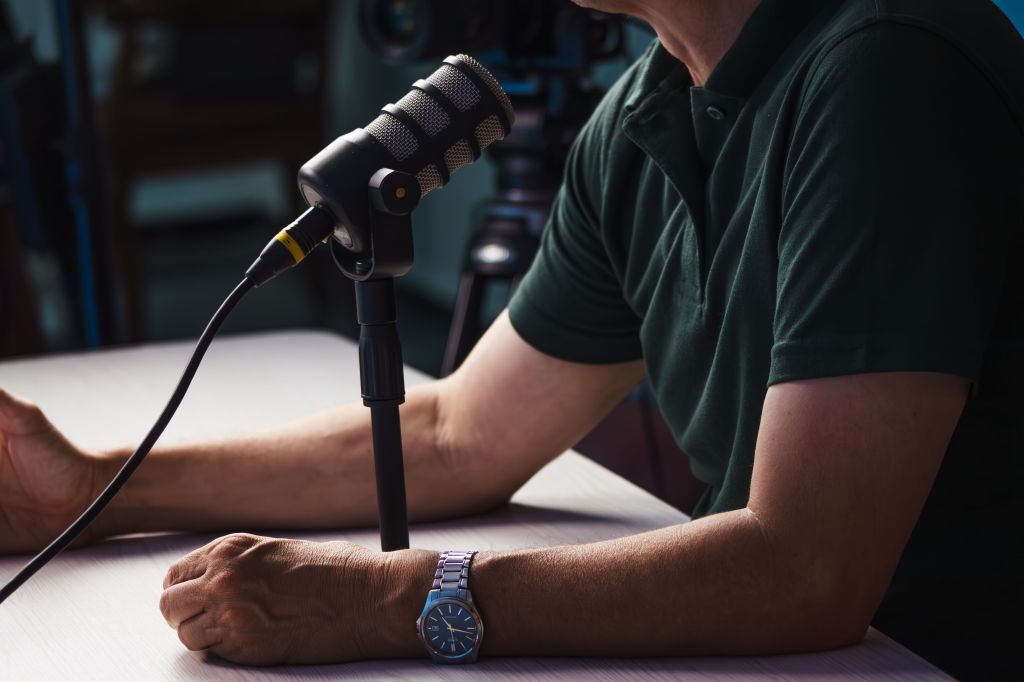
Giving a platform to so-called experts with no real standing in professional boards is legitimizing misinformation at a rapid rate. They may not be telling people to drink bleach like you-know-who, but they are still amplifying dubious claims built on weak correlations and questionable studies.
As an avid podcast listener and self-described BS catcher, I’ve noticed a pattern among major wellness and mindfulness interviewers: they once featured doctors and board-certified health professionals, and now they invite guests with “holistic” credentials and viral controversial takes on food and mental health, even when those claims have been challenged by the scientific community.
Colleague to colleague… What are we doing? Social media is still media, yet we’re suddenly holding it to lower standards of accountability and ethics than mainstream outlets, as if the responsibility to inform accurately belonged only to “formal” journalists bound by guild standards.
As the world shifts toward a more conservative political and social climate, we are also drifting away from scientific research. And what I see is that, instead of building a united front, we are sinking into nonsense because the algorithm rewards it.
And yes, there’s a difference between platforms owned by Elon Musk and Mark Zuckerberg, which can hide behind “free speech” to allow misinformation and deepfakes to spread, and journalists, interviewers, and commentators, who have a responsibility to challenge dangerous narratives rather than amplify them.
Platforms can claim they are simply hosting “debate,” but media figures still shape what people perceive as credible. To make matters worse, we give pseudoscience a polished stage without serious challenge. Instead of pushing back, we present these people’s messages as easy answers to complicated problems. We then nod along, and even ask for advice on behalf of our audiences. The audacity!
Guests selling detox myths, miracle supplements, or one-size-fits-all cures for anxiety and chronic illness; the interviewer who frames anti-vaccine talking points or “seed oils are poison” as if they are brave new insights; the platform that calls it “just asking questions” while giving fringe claims the same stage as evidence-based medicine; the host who lets a guest with no clinical oversight sound authoritative simply because they have a slick title, a viral following, and a story that resonates with the audience own frustrations. But, why are we doing this when we know better than to flirt with controversies and hypochondria?
People are exhausted and disillusioned
So many are fed up with systems that feel expensive and increasingly detached from real life. In the U.S., for instance, healthcare is hard to access, but globally, we are experiencing political polarization and inflation of the cost of living, which means that trust in institutions is steadily eroding.
In this kind of environment, “alternative” voices can sound refreshing and more rebellious. And that isn’t just a vague concern; A 2022 study published in Epidemiology and Infection by Hyemin Han and colleagues, drawing on a global survey of more than 12,000 people across 24 languages, found that conspiratorial thinking and anti-expert sentiment are strongly tied to lower trust in government, science, health systems, and the World Health Organization (WHO).
This is the breakdown of institutional trust
In other words, when institutional trust falls, people become more vulnerable to figures who present themselves as antidotes to the system. And we have seen it throughout history: in the late Roman Republic, widening inequality promoted by the elite opened the door leaders who dissolved the system like Sulla, Pompey, and Julius Caesar; in the aftermath of the Black Death and the Western Schism, the collapse of centralized religious authority created space for reformist and alternative voices to gain ground; during the interwar period, amid hyperinflation and political paralysis, distrust in Weimar democracy in Germany helped clear the way for extremist outsiders like Adolf Hitler; and in the 1970s, stagflation fed a surge of anti-establishment backlash.
Across these eras, the shift from institutional trust to anti-expert rebellion tends to follow a familiar pattern:
- Economic shock or cost-of-living crisis
- Institutions fail to protect and reassure people
- Mass disillusionment and erosion of the social contract
- Charismatic outsider voices rise by creating simple villains and offering easy answers.
The pattern is not that history repeats exactly, but that the same pressure points keep producing the same kind of break: crisis, disillusionment, and a scramble for someone, anyone who sounds decisive.
I’m not saying that the media should be pro-establishment and stop natural societal progress. This, for me, feels different. I sense that we are regressing.
And now, what 2026 is showing us is that people are tired and institutions feel hollow. In that vacuum, pseudoscience doesn’t have to prove itself — it only has to sound certain… Almost feel rebellious, like if science is something you either believe in or not.
That is why these guests keep getting booked, why they keep going viral, and why so many platforms keep mistaking provocation for insight.
The public perception of the scientific community
The skepticism toward science we are seeing often misinterprets rigorous standards as elitism, overlooking the scientific community’s core mission of public service. But, as Jasmine Mohsen points out in Psychology Today about what’s behind this wave of anti-intellectualism, plenty of people who distrust experts aren’t incapable of thinking, they just pick and choose who they trust, and a lot of that comes down to what expertise seems to stand for in times of polarization and economic constraints: hierarchy, exclusion, and a bit of condescension.
The media needs to reinforce that expertise and specialized training are not tools for exclusion; they are essential defenses built to protect the public from dangerous misinformation and unverified claims. It might mean that we need to go back to basics.
The scientific method is inherently collaborative, self-correcting, and transparent, relying on peer review to ensure that facts—not hierarchy—dictate the truth. When researchers stand firmly behind their data they are not being condescending. Regardless of what we’ve been told in school about scientific research, knowledge feels muddy now. The sentiment is everywhere online and offline. For a lot of people the scientific world can come across as distant, too sure of itself, and tangled up with institutions people already don’t trust. So instead of looking like public service, expertise starts to look like gatekeeping.
Labeling the scientific world as an “elite gatekeeper” dismisses the tireless, often thankless work of thousands of researchers.
Sadly, once science sounds like another elite voice talking down to everybody else, people tune out fast, even when the evidence is right there. Add in a moralizing tone, and you’ve basically handed skeptics the perfect excuse to push back.
Who benefits from the spread of these beliefs?
The real conspiracy is that the spread of these beliefs is not accidental. It rewards the hosts who convert distrust into views, and the grifters who turn confusion into cash with courses and coaching sessions that promise to do the impossible.
Regardless of the obvious, the bigger picture is that science itself is becoming a political target globally.
The spread of anti-expert sentiment is happening at the same time that governments are actively weakening the institutions meant to produce and protect knowledge. In the U.S., federal cuts, grant freezes, and ideological reshaping of research funding are hitting climate science, public health, and universities especially hard. Agencies like the NSF, NIH, EPA, and CDC are facing reductions under the Trump administration. And because U.S. institutions fund so much international work, the damage does not stop at the border. Joint projects are disrupted and other countries are now scrambling to build independence from American research money and data.
As Humberto J. Debat argues in an eLife Point of View piece, science is under threat around the world. He shows that governments in Argentina, the U.S., the Netherlands, and the U.K. are all reducing or freezing research in certain fields (climate, health and social issues) for considering them politically inconvenient.
Even Nature has warned that governments should be careful not to deprioritize curiosity-driven research in favor of short-term political goals. In its February 2026 editorial, the journal argued that while public funding should reflect broad societal needs, heavy-handed interference risks damaging the kind of investigator-led science that has historically produced major breakthroughs in medicine, genetics, and technology.
The problem is bigger than science being mocked online. What we are seeing is science being pulled from above into the shape of politics. Once governments decide research has to answer to messaging first, they undermine the very independence that makes science worth trusting at all.
Many other interests are in conflict and overlapping pressures from commercial and technological forces, aligned to weaken scientific research and maximize corporate profits.
AI companies also benefit when climate science gets less attention, because it becomes easier to ignore the environmental cost of their own data centers, which use huge amounts of energy and water. Oil and gas interests profit when climate science is delayed and turned into one more partisan fight, because doubt buys time and time buys profit.
And governments, under pressure from lobbying and ideology alike, benefit when inconvenient evidence can be reframed as political messaging.
This dynamic was on full display at Donald Trump’s second inauguration, where fossil fuel billionaires and Big Tech CEOs stood side-by-side. Since then, the administration has gone all-in on artificial intelligence, actively lobbying alongside tech giants to dismantle oversight and even altering EPA public engagement rules to fast-track the construction of the gas plants needed to power massive data hubs. At the same time, the oil and gas industry—which poured over $19 million into Trump’s inaugural fund—has successfully weaponized this alignment, using its historic access to secure a “national energy emergency” declaration and lift limits on liquefied natural gas exports.
How can we push back this trend?
As independent journalists and digital creators, we frequently pride ourselves on being the antidote to legacy media’s systemic failures. We have built unprecedented communities on the promise of authenticity and unfiltered truth. Yet, our current operational model is actively compromising the very credibility we claim to defend. In all honesty, it’s just a louder, lazier version of the problem.
In this post-truth environment, every instance where we platform an unverified assertion without immediate, evidence-based challenge further degrades public trust. We can no longer afford to mistake passivity for objectivity. Treating bad-faith arguments or demonstrably false claims as merely “another point of view“ does not serve our audience.
Instead, we are accelerating a cultural shift where reality is entirely negotiable.


Comment